This article is republished from アジア財経観察
By Li Da in Tokyo
Japan, South Korea and China are confronting the same demographic challenge at different speeds: how to care for rapidly ageing populations without overwhelming families, public finances or the labor market.
All three have built their systems around long-term care insurance, but their strategies are diverging. Japan is betting on robots, South Korea on AI-powered monitoring, and China on a combination of policy support and market scale.
The real competition is not simply about who adopts more technology. It is about who can provide broader, more affordable care.
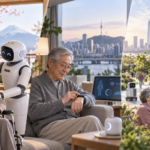
Japan: Betting on Care Robots
Japan has one of the world’s oldest populations, with 36.2 million people aged 65 or above, accounting for 29.4% of the population.
Its response has increasingly centered on robotics.
In 2026, Japan expanded subsidies for care robots, with some programs covering up to 75% of purchase costs. The government is also encouraging mass production in an effort to bring down prices that remain too high for many smaller care facilities.
Japanese startup ZEALS, for example, launched the humanoid robot D1 in August 2026, targeting practical use in elderly-care settings rather than laboratory demonstrations.
Japan’s strategy reflects a basic reality: robots are being used less to replace workers than to compensate for chronic labor shortages and reduce physically demanding care work.
South Korea: AI Before the Emergency
South Korea is taking a more preventive approach.
In April 2026, the government announced a national strategy for AI-based care, combining artificial intelligence, IoT sensors and health data to detect risks before accidents or serious deterioration occur.
Large companies are moving quickly into the sector. Samsung C&T has introduced AI elderly-care systems in senior housing, using sensors to monitor sleep, heart rate and daily activity, while its EverRing platform provides personalized health and lifestyle support.
Seoul has also started using AI and wearable devices to monitor elderly people living alone in public housing.
The goal is clear: improve efficiency and reduce the financial burden of long-term care, which has risen sharply in recent years.
China: Scale as an Advantage
China is following a broader model in which government policy and commercial expansion reinforce each other.
Authorities are promoting AI, big data, smart monitoring and elderly-care robots, while encouraging companies to develop age-friendly products and services.
The market is already enormous. China’s smart elderly-care sector was estimated at RMB7.21 trillion in 2025 and is expected to continue expanding rapidly.
But China’s biggest challenge is inequality.
Major cities are building high-end smart retirement communities, while many smaller cities and rural areas still lack basic digital elderly-care infrastructure.
That means China cannot rely on a single model. Its market will require both premium solutions and affordable, widely accessible services.
Three Models, One Challenge
| Dimension | JA Japan | KR South Korea | CN China |
|---|---|---|---|
| Core Approach | Robotic Care | AI Health Monitoring | Smart Elderly Care |
| Main Driver | Government Subsidies + Industrial Policy | Conglomerates + Government Strategy | Policy + Market |
| Key Data | Up to ¥40 million subsidy per facility | KRW 14.7 trillion in long-term care expenditure | RMB 785 billion market size |
| Technology Focus | Humanoid Robots, Care Assistance | IoT Monitoring, Conversational AI | Big Data, AI, BeiDou |
| Underlying Model | Robots Fill Labor Shortages | Technology Prevents Risks Before They Occur | Technology Empowerment + Human-Centered Care |
Japan has robotics but faces high costs.
South Korea has advanced AI monitoring, but technology still cannot replace human care.
China has scale, but also a wide regional gap.
The three countries are taking different routes toward the same goal: using technology to make ageing more manageable without losing the human side of care.
In East Asia, the future of the silver economy may not belong to one model alone.
It may come from combining Japan’s robotics, South Korea’s AI and China’s scale.